
Type of Project:
End of Studies (ISART Digital)
Time spent on Project:
8 Months
Platforms:
Oculus Rift S, Oculus Quest
Used Softwares:
Google Suite (Docs, Sheets,
Slides, Forms)
Draw.IO
Twine
Unreal Engine
Concept
Because I Love You is the end of studies project I’ve worked on during my Master’s Degree graduation year. It has been showcased to the Jury on May 28th, 2020.
Dive in a psychological thriller set in virtual reality, face your deepest fears in a constantly evolving environment.
Because I Love You is a narrative game relating domestic violence. Our goal in terms of game feel was to rise fear, anxiety, and thoughts of being manipulated in the players’ minds.
Role in Production
For this project, I’ve worked on the following subjects: Game Design, Level Design, Narrative Design, User Research, UX Design and UI Design. The different tasks that I’ve completed for these subjects are listed below.
Production
Game Design
As a Game Designer, this project taught me much. I’ve mostly worked on games that were built on specific mechanics, features or systems, and less on its narration. BILY was different to these projects as the gameplay is centered on the painful everyday life of a domestic violence victim. To engage the player in such a serious subject was our biggest challenge.
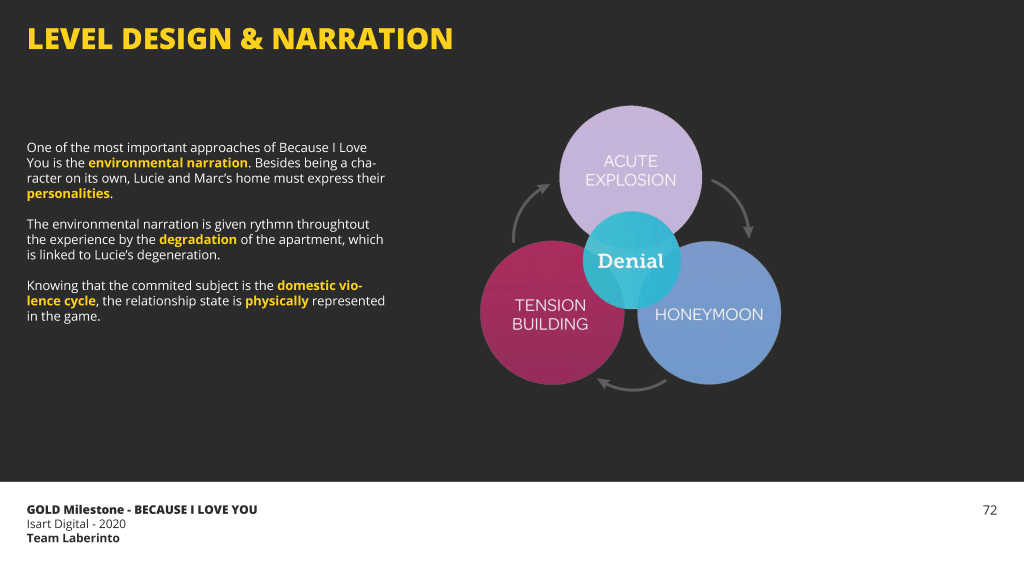
To reach what we wanted as a game experience, we decided that our gameplay would to hinge on the repetition of a micro game loop: a chore to complete each day. These chores are affected by the degeneration which Lucie suffers from. Each day that passes in Because I Love You represents a chapter in-game that’s following the cycle of domestic abuse. During each of these days, a key element appears: the Safe. Lucie discovers her it for the first time at the start of her degeneration, and it contains the secret behind it. The safe’s linked to the macro game loop: Lucie facing her relationship with Marc degrading itself, and being forced to find how to open the safe in order to find the answer she’s looking for.
Added to all the different produced documents throughout the development of BILY, we made this Game Design Document that explains the entirety of the game content and our creative vision.
You can download below the final version of the GDD.
Level Design
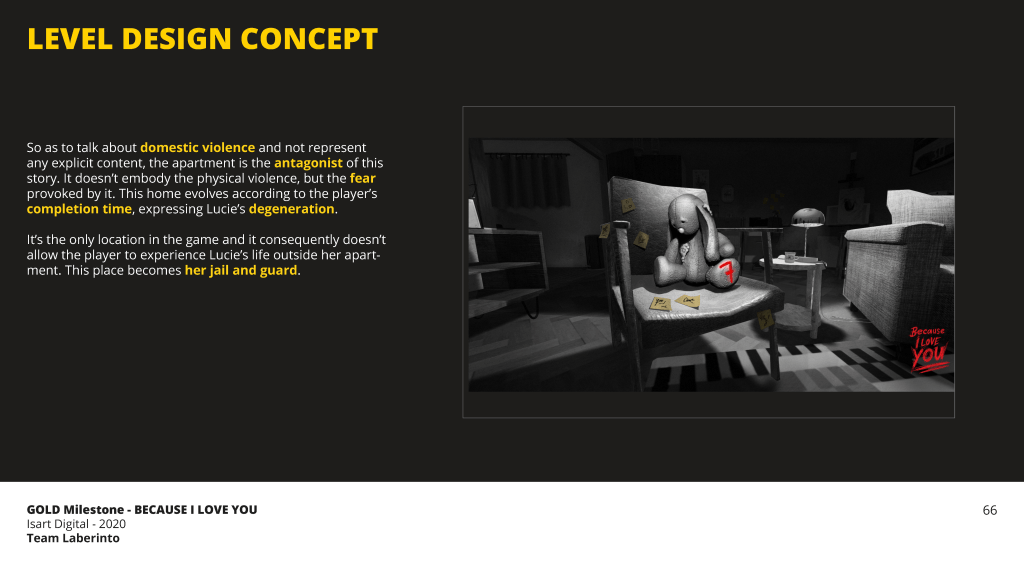
In Because I Love You, the Level Design is an important matter. The apartment in which Lucie evolves represents the danger that she faces throughout the game.
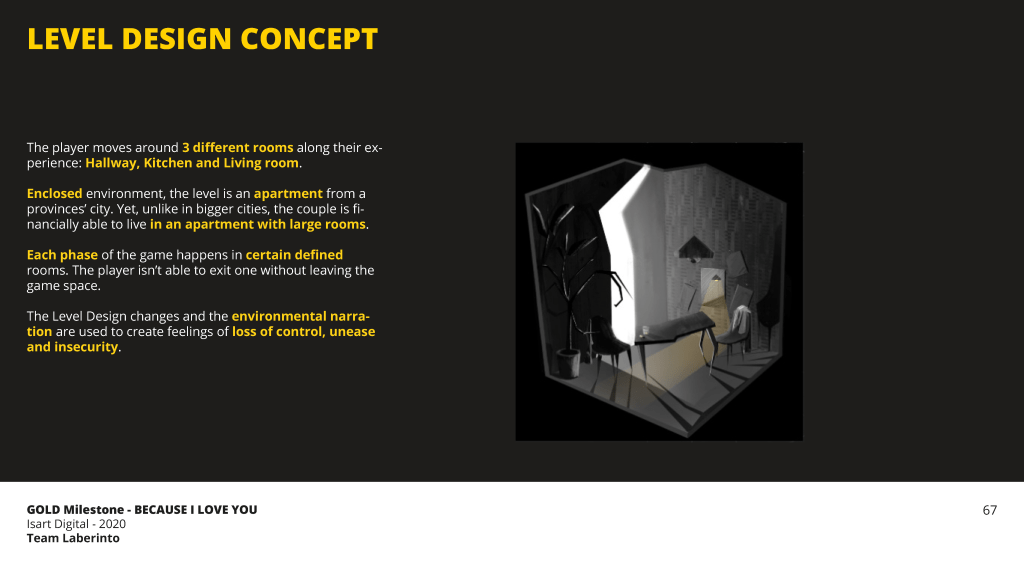
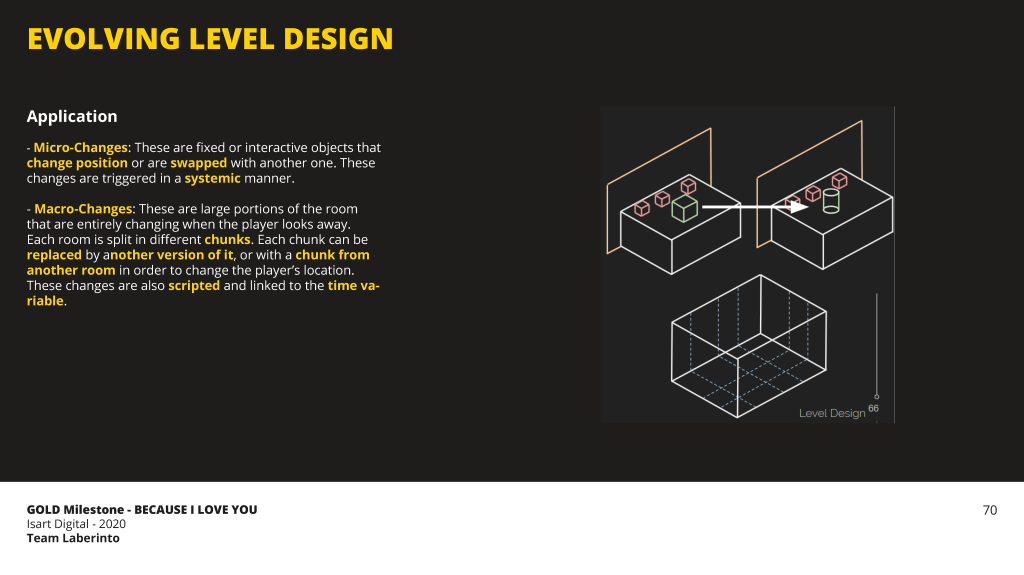
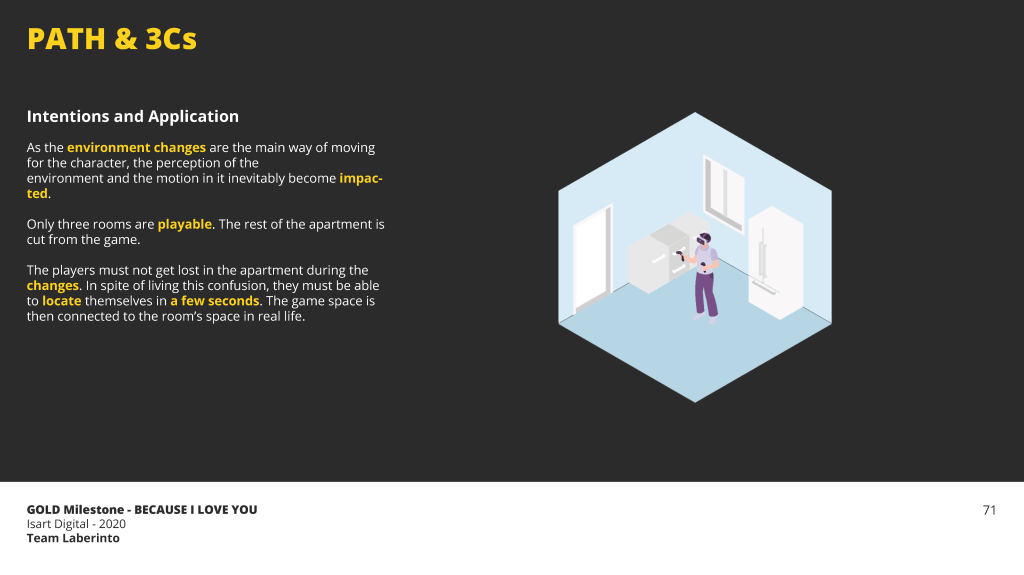
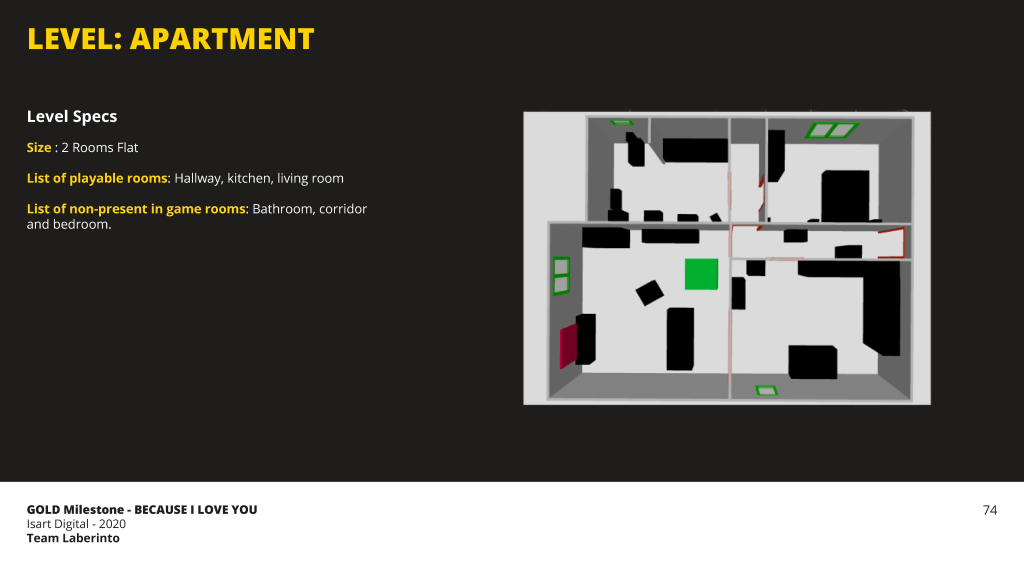
The entire game occurs in it, and the apartment is shown under three different states of degeneration. Only certain defined rooms are available for the player: the corridor, the kitchen and the living room. In order to reach our scope, we chose not to use the other rooms of the apartment as it would have made a huge difference in our workload.
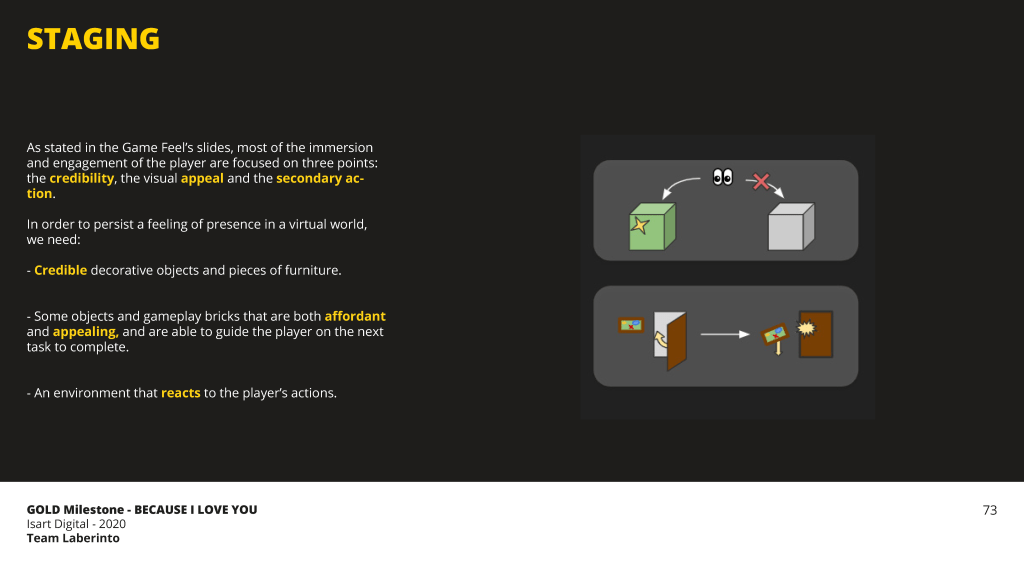
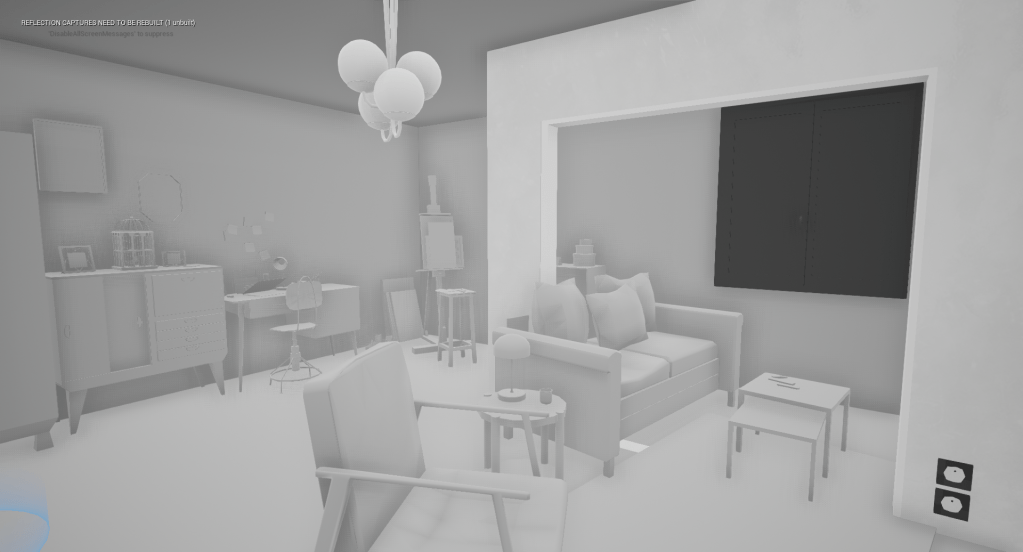
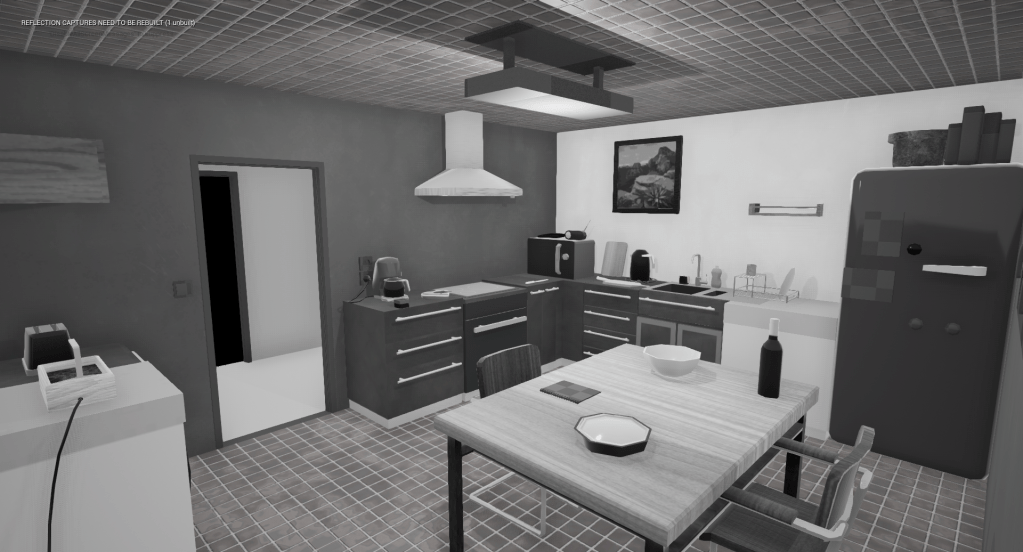
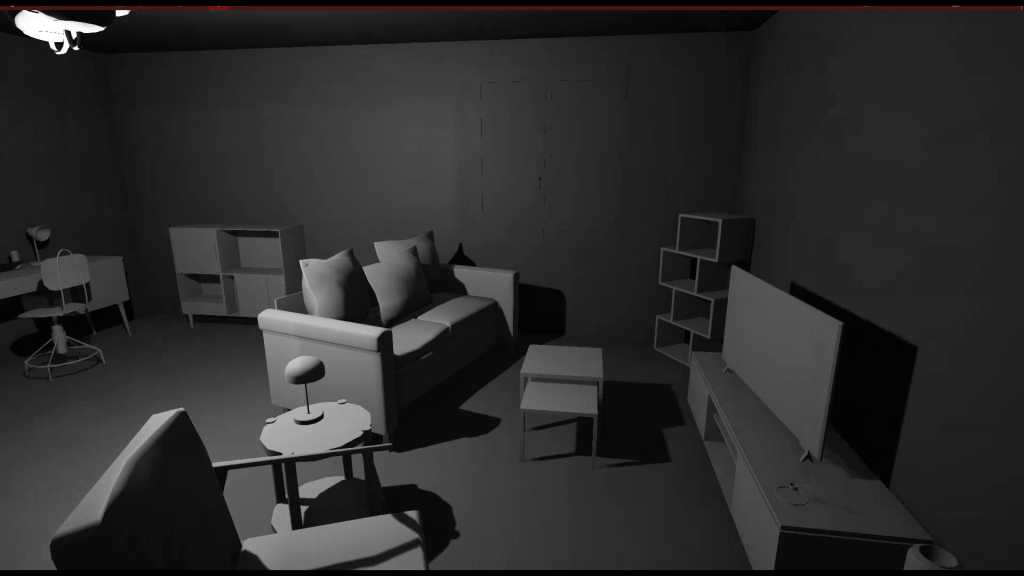
In each of these rooms, we used the environment to tell as much information as possible about our characters, Lucie and Marc, without needing to use classic narration methods (cinematics, written/oral dialogs…].
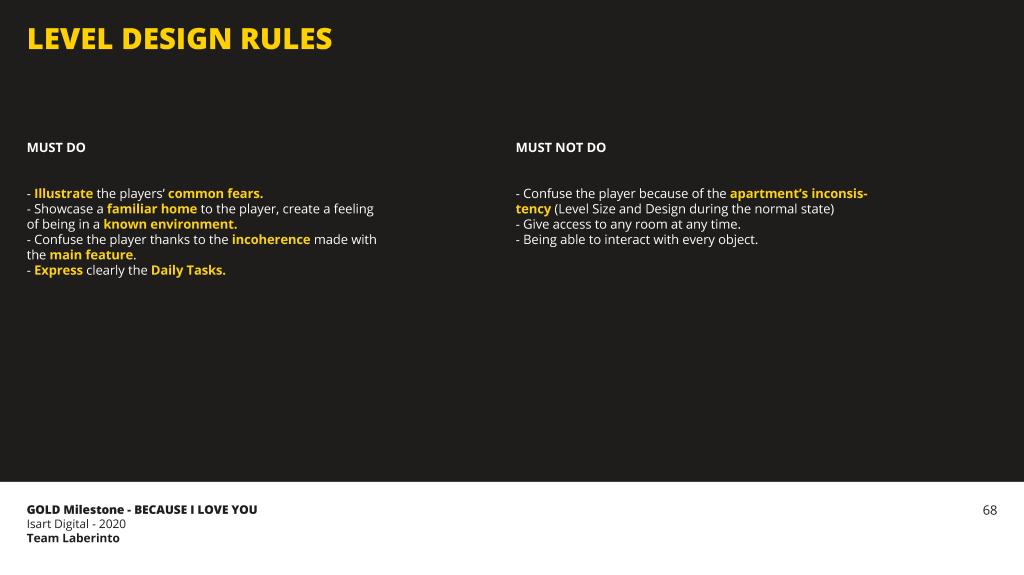
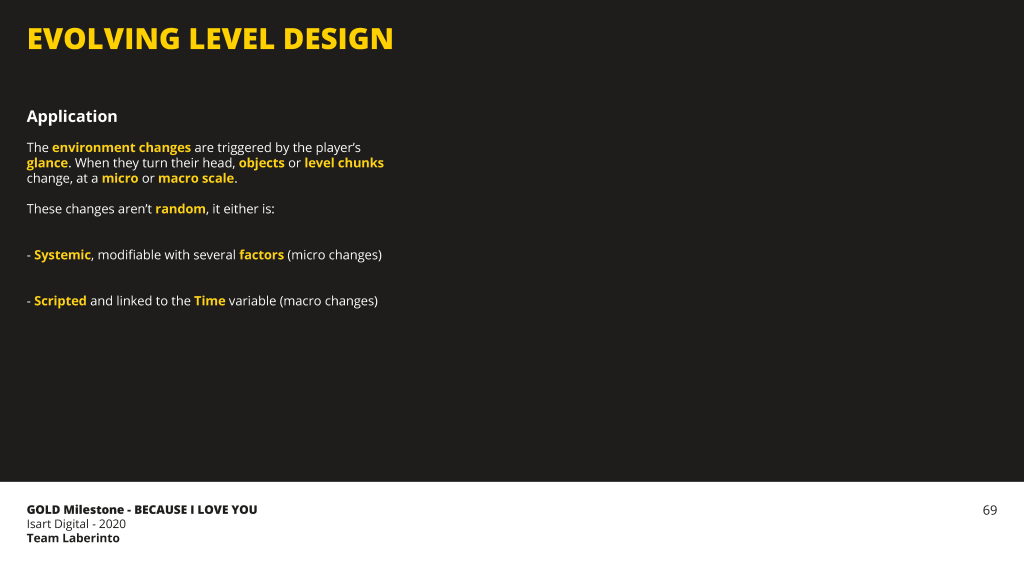
At first, I worked on a Level Design Document that was separated from the Game Design Document, so it would be easier for Artists to quickly get information about the models we would be needing from them. Eventually, I joined it to the Game Design Document that you can download above on this page. You can find below some screenshots of the document below, and some screenshots of the level as well.
Narrative Design
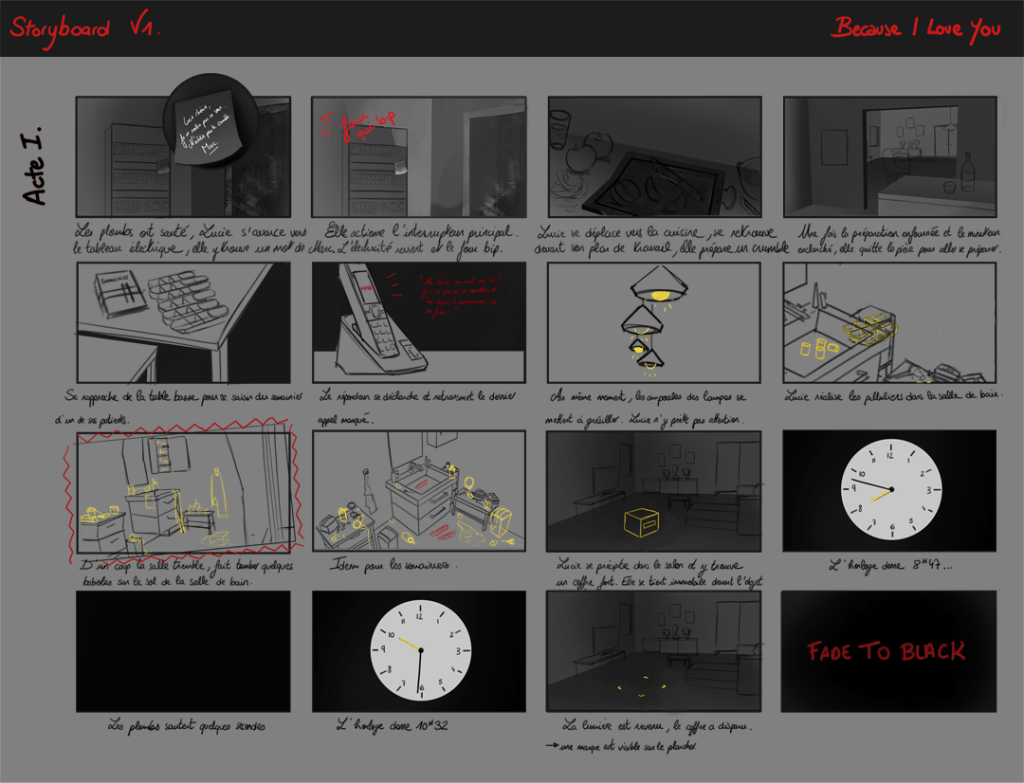
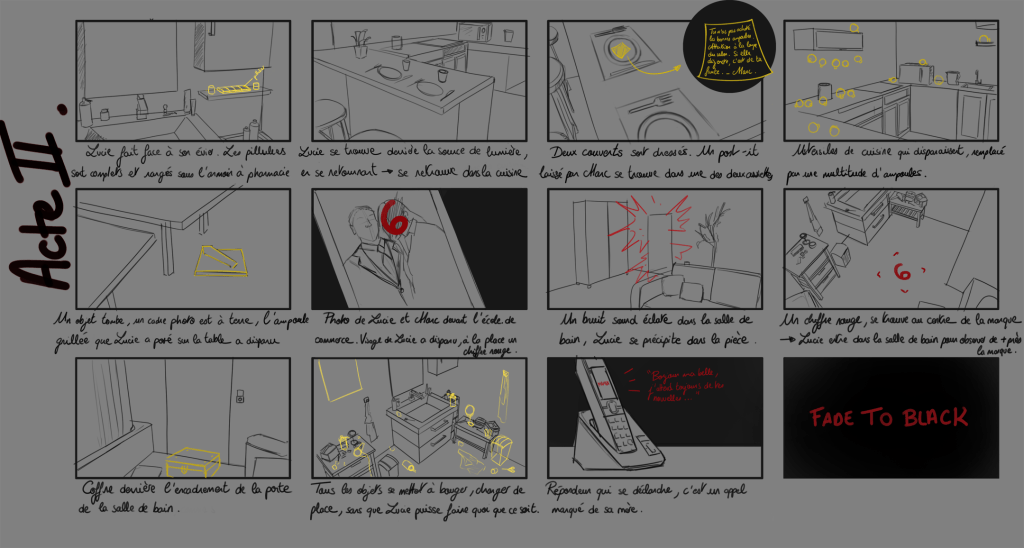
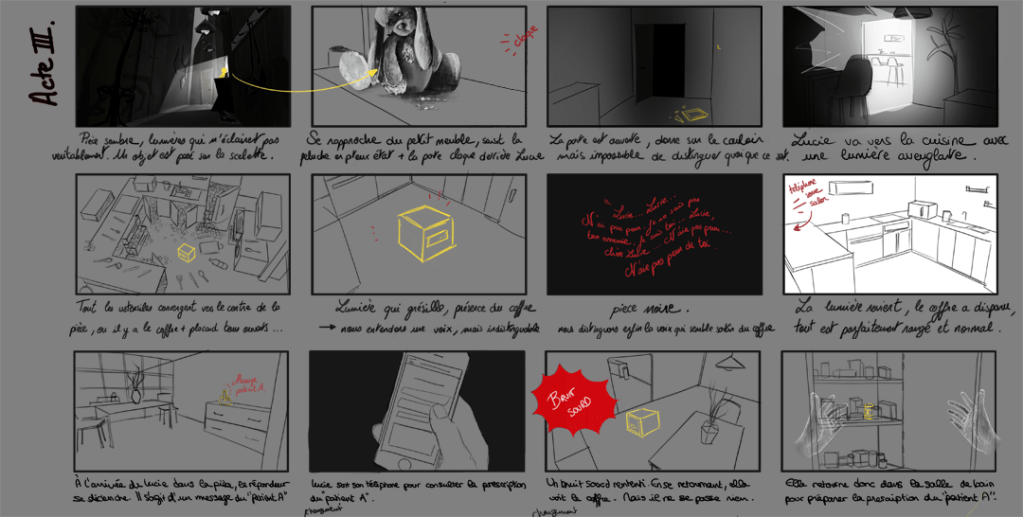
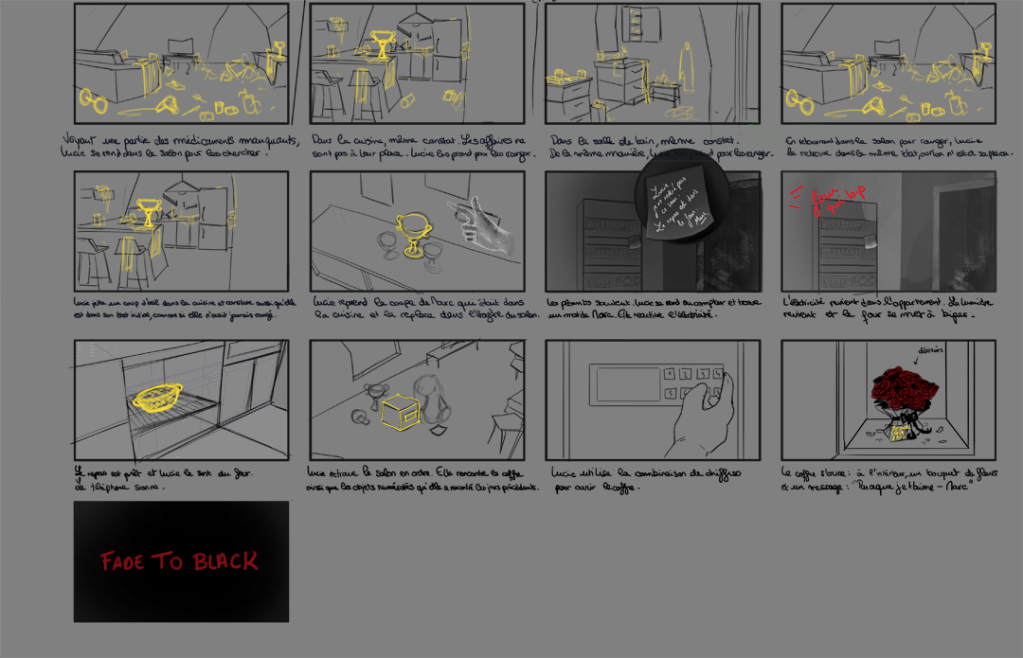
As stated before, Narrative Design was a major subject for Because I Love You, as it’s a story-driven game. Until the Gold Milestone, the Narrative Design is the only part of our work that may be modified. We never stopped thinking about developing our characters’ personalities, the scenario, and the combination with the Walkthrough and the Game Loops.
You can see below some screenshots of our early Storyboard.
UX Design
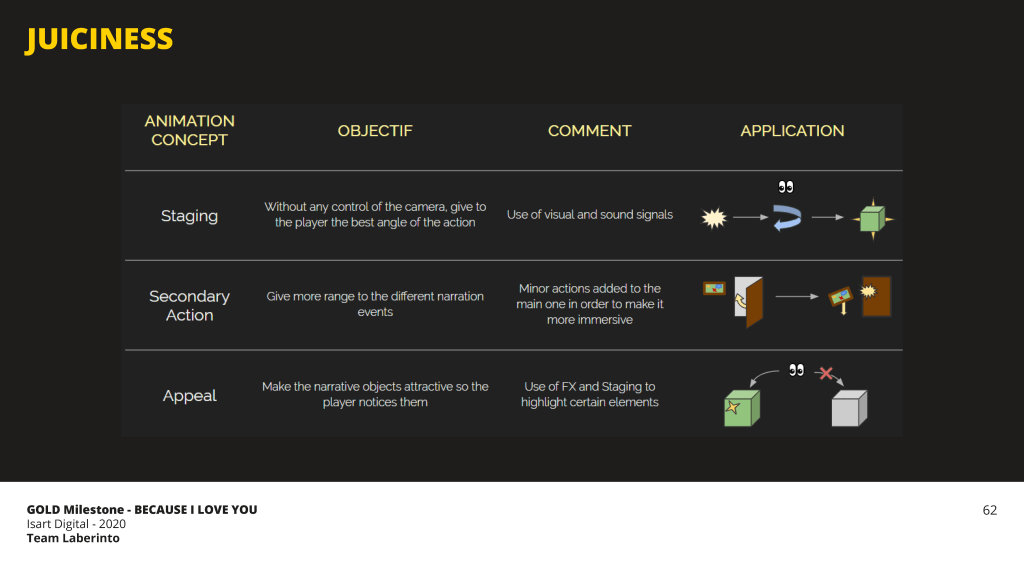
We had a clear vision of what we wanted for the User Experience: Because I Love You is a stressful game. The game’s antagonist isn’t Lucie’s husband, but the apartment she’s stuck in. Her only way out is the safe that appears abruptly, at the same time that the degeneration starts. As the unease grows in the player’s mind, they will be forced to focus on the safe in order to escape the danger.
We defined a few application methods that you can find below:
UI Design
In terms of interface, we changed our minds several times during the production. At first, in order to keep the experience as immersive as possible, we designed an intradiegetic interface represented by different props disposed in the level (vinyl player, electrical board, smartphone).
After testing it and some thinking, we concluded that this interface would present two major issues:
- Throughout the game, we deliberately block the player in certain rooms/parts of the level. Doing so blocks the player from accessing all available Options (Volume, Language, even the Quit Game option!). We believe that it’s mandatory for the player be able to access these at any time while playing.
- Our target audience isn’t the most at ease with virtual reality. The idea of an intradiegetic interface isn’t the most well-known, so we would rather keep it easy to access and quick to understand for any player.
Thus, we changed our UI and make a simplified fixed UI, whether in the Main Menu or in the Pause Menu.
User Research
We integrated User Research in our workload around the 3C and the Alpha Milestones. During that span of time, I defined the Research Axis for BILY, then produced the documents that would collect the playtesters’ feedbacks and synthesize it.
Originally, the Playtests were planned to occur during the second half of March but we had to cancel all of them because of the Covid-19 Pandemic. As we needed these feedbacks one way or another, we turned to Oculus forums to ask Rift S and Quest owners to playtest the game from home.
Gained Experience
This project was the first one that I’ve worked on for a long period of time with a full team. Its production was a challenge for several reasons: the game’s genre (Psychological Thriller), the societal problem mentioned by the game, the production for two different VR platforms with each their own technical capacities and restrictions and the Covid-19 pandemic that was just starting. Our team has been in difficulty for almost the entirety of the production. This type of project was rarely suggested as a pitch to the Jury, and even less often approved by them. Having it as an End of Studies project was a great opportunity for me to practice and learn instead of reproducing game genres, features and systems I’ve already done at least once. I believe I made a good choice by picking this project.
Also, the research work I’ve made to learn more about this subject made me meet inspiring beings. Whether psychologists, university lecturers, designers or human beings that experienced domestic violence, I know more about this problem now, and feel more able to talk about delicate subjects in my future projects.
Walkthrough
Credits
Game Art
- Sarah Albini
- Candice Dugal
- Laura Kerleu
- Élisa Péron
Game Design
- Vincent Dupont
- Paul Muller
- Florine Tauran
Game Design Programming
- Paul Moulin
- Arthur Schmitz
Game Programming
- Adrien Bourgois
- Adrien Hébert
- Charles Seizilles de Mazancourt
Producing
- Dimitri Martirosyan
- Antonin Vautier
Sound Design
- Simon Amiot
 Vincent Dupont